Saturday, April 13, 2013
So let it be with Caesar,

For those of us lefties who were adults during that grete angur and unhappe of the Thatcher years the News has been a no-go area for the past week, swamped as it has been by accounts of her time in office, reports of international reaction to her death and hagiographic tributes from former colleagues. And all this will be capped by - in all but name - a state funeral next Wednesday.
I wondered why the demise of this elderly semi-alcoholic alzheimer sufferer should engender quite so much attention. Her death changes nothing: we may have lost the woman but her legacy is all around us in a de-industrialised Britain, an unregulated City, a rapidly disappearing NHS, under-financed public services, the yawning chasm between the income of ordinary, honest workers and that of the tax-avoiding incompetents who help themselves to massive unwarranted bonuses and pensions paid for by the taxpayer, and the xenophobia remorselessly drip-fed into their readers by the Sun and the Mail. An article by Jonathan Freedland in Tuesday's Guardian enlightened me:
'The wider Tory tribe seems determined to use the nine-day limbo between her passing and her funeral to define Thatcher in death in a way that would have seemed impossible, if not outright absurd, in life: as above and beyond politics, as a national rather than partisan figure, as an incontestable and uncontested part of our collective inheritance.'
Freedland also reports Lord Powell's claim that Thatcher would have been disappointed if there hadn't been people figuratively dancing on her grave. And one can understand why. Channelling people's anger into self-satisfying but futile protests is a classic diversionary tactic. As Mark Antony said apropos of Caesar: "The evil that men do lives after them ..." It's Thatcher's evil legacy that people need to fight not the woman herself.
I have always had some sympathy for apokatastasis, the heresy commonly - though possibly erroneously - associated with Origen. It teaches that everyone, including Satan himself, will ultimately be saved. One could argue that no one is totally bad - Hitler was very fond of his dog Blondi. Hardly outweighs murdering six million Jews, but could be something to build on. Thatcher, despite her euroscepticism did physically reconnect Britain with the mainland for the first time since the last ice-age. Though she may have been more concerned with its oil-fields than with its people's liberty, she was quite right to defend the Falklands. The islands may be nearer to the Argentine than to the UK, but 1521.39 kilometres is still a heck of a long way. If the Argentinian criterion for exercising sovereignty were universally applied we'd have instant European political unity. The Italians could claim that the Angles, Saxons, Germans, Goths, Vandals etc are all illegally occupying the territory of the Roman Empire and should subject themselves to the Pax Romana forthwith.
Sadly, whilst slightly more creditable than liking a dog, Thatcher's two positive achievements hardly counterbalance the enormous harm her legacy continues to inflict. As Romano Prodi commented last Tuesday she:
'cambiato il mondo', ma la sua rivoluzione liberista ha portato 'all'aumento delle differenze fra ricchi e poveri' ed ha 'certamente aiutato e forse provocato' la crisi economica mondiale [changed the world, but her revolutionary introduction of economic Liberalism has brought about an increase in the gap between the rich and poor and has certainly helped, and possibly provoked, the global economic crisis].
Unfortunately, not only did Prodi's remarks attract a lot of negative comment from the Twitter-sphere - the refuge of those who, incapable of formulating an argument, imagine a badly expressed opinion is an acceptable alternative - but the Corriere della Sera, Italy's equivalent of the Guardian, has carried articles broadly supportive of her policies. That does worry me. The German dog-lover's legacy was destroyed by the Red Army and the western allies. His ideals only live on in the minds of a tiny minority of brutish morons. Would that the same could be said for those of the Iron Lady.

Friday, April 12, 2013
Saved by the bell.

A couple of weeks ago I took my watch to the jeweller to have its grommets replaced. Although it's supposedly waterproof, when I sweat profusely its dial becomes cloudy. Having the grommet at the back of case replaced cured the problem for a while, but when it reoccured the jeweller advised me to have the one behind the winder replaced as well.
In the watch's absence I've been keeping track of time with an iPhone app called Westminster Chimes which strikes the quarters as well as the hours. It may drive Pat mad, but today it was a life-saver.
This morning I'd gone to Comunanza to pick up my Italian driving licence and to have the car cleaned. Shortly after moving here I had my licence officially recognised by the Italian equivalent of DVLA. It was cheaper than exchanging it for an Italian licence. Every few years I'd go for an eye-test and the licence would be updated by means of a sticker on its back. The most recent update lasts until 2014. Now while that's fine for driving in Italy, as the English licence expires when I'm seventy this June, I envisaged enormous problems if I needed to hire a car in the UK thereafter. Would your average Hertz employee - at Stansted many of them are Eastern Europeans - realise that despite the licence itself saying it had expired, the bit of paper stuck on the back made it ok? Somehow I doubt it. And if at some future date we had the misfortune to move back to the UK would Swansea happily renew a licence which had expired some years previously. I did put the question to them several months ago by email. I'm still awaiting a reply, but I guess the answer would be no. So, I've coughed up €80 and am now the proud possessor of a kosher Eyetie licence.
Having collected the licence I went for a coffee until it was time to pick up the car from the car-wash. That done, I drove home.
Mid-afternoon I thought I'd check the state of my iPhone's battery; went to pull it out of my pocket - and found it wasn't there. Searching the house failed to find it, as did ringing it from the landline. The obvious answer was that I'd left it in the car. Unfortunately, searching the car proved to be equally unproductive. I then began to panic: had I left it in the bar? The Find My Phone app failed to locate it. Applying electrodes to my one remaining brain cell produced a result: I remembered that I had the phone when I arrived at the garage to pick up the car, ergo despite my failing to find it it must be in the vehicle. So I went back to the car. As I opened the door I heard a blessed sound: my phone striking half-past. A prolonged search eventually discovered it hiding beneath the front passenger seat.
Although I was quite cross with its naughty behaviour - don't be fooled, these inanimate objects have minds of their own - like any loving parent I soon forgave it in my delight that it was safely home once more. And all thanks to Westminster Chimes.
In the watch's absence I've been keeping track of time with an iPhone app called Westminster Chimes which strikes the quarters as well as the hours. It may drive Pat mad, but today it was a life-saver.
This morning I'd gone to Comunanza to pick up my Italian driving licence and to have the car cleaned. Shortly after moving here I had my licence officially recognised by the Italian equivalent of DVLA. It was cheaper than exchanging it for an Italian licence. Every few years I'd go for an eye-test and the licence would be updated by means of a sticker on its back. The most recent update lasts until 2014. Now while that's fine for driving in Italy, as the English licence expires when I'm seventy this June, I envisaged enormous problems if I needed to hire a car in the UK thereafter. Would your average Hertz employee - at Stansted many of them are Eastern Europeans - realise that despite the licence itself saying it had expired, the bit of paper stuck on the back made it ok? Somehow I doubt it. And if at some future date we had the misfortune to move back to the UK would Swansea happily renew a licence which had expired some years previously. I did put the question to them several months ago by email. I'm still awaiting a reply, but I guess the answer would be no. So, I've coughed up €80 and am now the proud possessor of a kosher Eyetie licence.
Having collected the licence I went for a coffee until it was time to pick up the car from the car-wash. That done, I drove home.
Mid-afternoon I thought I'd check the state of my iPhone's battery; went to pull it out of my pocket - and found it wasn't there. Searching the house failed to find it, as did ringing it from the landline. The obvious answer was that I'd left it in the car. Unfortunately, searching the car proved to be equally unproductive. I then began to panic: had I left it in the bar? The Find My Phone app failed to locate it. Applying electrodes to my one remaining brain cell produced a result: I remembered that I had the phone when I arrived at the garage to pick up the car, ergo despite my failing to find it it must be in the vehicle. So I went back to the car. As I opened the door I heard a blessed sound: my phone striking half-past. A prolonged search eventually discovered it hiding beneath the front passenger seat.
Although I was quite cross with its naughty behaviour - don't be fooled, these inanimate objects have minds of their own - like any loving parent I soon forgave it in my delight that it was safely home once more. And all thanks to Westminster Chimes.
 Posted with Blogsy
Sunday, March 31, 2013
The Courtyard Circular: March 2013

The two principal events this month were our trip to Dubai from the 7th to the 17th

and the arrival of Pat's new horse, Daisy on the 21st.
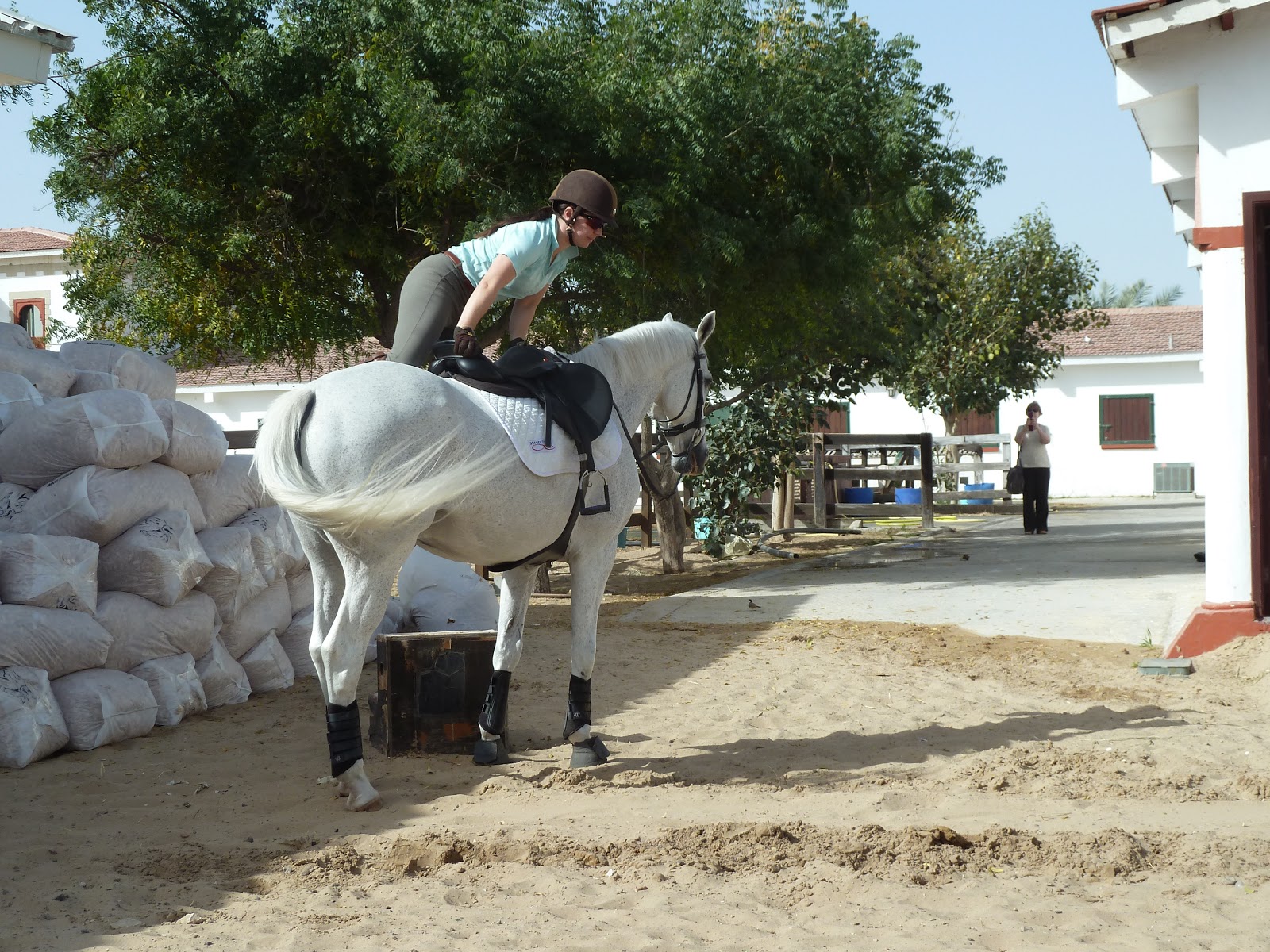
We first saw Daisy on the 5th January at the Centro Ippico Balduccia, Sant'Arcangelo di Romagna near Rimini. Various events, including Pat breaking her arm, and our trip to Dubai precluded her arriving earlier.
Warren stayed with us for a few days. He arrived on the 22nd having driven over from the UK to work on his house. He brought with him a huge box of much appreciated English goodies that his partner, Rachel, had put together for us. He left in the small hours of the 26th. We miss him.
Jane Fineren arrived in Italy while we were in Dubai and stayed until the 27th. She came up to the house a few times and went down to Centro Ippico San Lorenzo to see Daisy. Unfortunately, having fallen off a ladder whilst attempting to trim a creeper on her house she was unable to ride.
Lastly, Peppe and Angiola came to Montefalcone last Thursday and we had lunch together at Lupo's.
Friday, March 22, 2013
Legless in Dubai

Last Sunday we got back from ten days with Sophy and Adam in Dubai. I went still suffering from the sciatica which had arrived on the 17th February. After a fortnight I'd realised it wasn't going to disappear of its own accord so I went to my GP who confirmed my self-diagnosis and gave me some pills. Unfortunately, they didn't effect a magical cure and although the pain abated my left leg is still flapping about like some semi-autonomous accessory rather than an integral part of my body.
Saturday 9th. Went to the fourth birthday party of a the child of some friends of Sophy and Adam.

Sunday 10th. In the morning Pat went riding with Sophy at the Desert Palm. In the afternoon Sophy and Adam took their mothers for a Mothering Sunday tea.
Monday 11th. In the morning I went to the Creek and bought spices.

In the afternoon to the Mall of the Emirates to meet Sophy and Pat who'd been there to have their nails done.
Tuesday 12th. In the morning I went to the Creek with Adam for lunch whilst Pat went to see Sophy's dressage horse.

In the evening we went to the terrace of the Palace Hotel for Thai meal with Adam, Sophy and Judi from whence we watched the spectacular fountains of the Burj Khalifa.
Wednesday 13th. To Al Ain zoo with Sophy and Adam.

Thursday 14th. To Judi's to help her scan documents for a family history.
Friday 15th. To Desert Palm for Spinney's Cup. Despite disastrous dressage and indifferent show jumping Sophy came third overall owing to sterling cross-country performance.

Saturday16th. Pat went riding with Sophy in the morning. In the afternoon we walked to the Madinat. In the evening to see Lisa's horse and then to Bab al Sharm for dinner.


Sunday 17th. The plane was late leaving which meant we had very little time to find the coach to Pedaso. Unfortunately its stop had changed location - it's now at posto 35 - so we missed it and had to wait three hours to get the next one at 5 pm. Got home at 10.30 to rain. Fortunately unlike our return home in 2008 the freezer's contents hadn't melted owing to a power cut!
Tuesday, February 26, 2013
Here be spiders.
As this post bears witness, I find the Web and the digital world in general very useful. They are integrated into my daily life, whether it be reading the Corriere and the Guardian on my iPad, emailing and texting family and friends, shopping on-line, navigating, accessing British television via VPN, seeking out information, or setting my Sky box to record a programme using the Sky Guide Italia iOS app. They are also destroying democracy as today's Italian general election results bear witness.
The problem with instant communication is the way it insidiously blurs the boundaries between the real and the spurious. Let's begin with friendship. Only a few of my real friends belong to Facebook, and the majority of those who do rarely use it. If they want to contact me they send an email. Their attitude to Facebook is neatly encapsulated by this post from Matthew: "First look at facebook for about a year. Must be because Charlie has been away for a week looking after her sick mother and I'm starved of human interaction. Hi everyone". But I have Facebook "friends" - people I barely know who sent me a friend request which I felt it would be impolite to refuse - who post frenetically every damned day. Here are is a selection from one of them (original punctuation): 15th Feb, "grrrrrrrrrrrrrrrrrrrrrrrr am soooo fed up", 12th Feb, "I suppose when the pope leaves he will have to stop wearing dresses!!!", 10th Feb, "what agreat sunday guests for sunday lunch then curled up watching another great film.every which way but loose..........right turn clyde!!!!love it", 1st Feb, "are my ears playing tricks on me????am i hearing things????a cuckoo already......."
Like this blog, they're simply a sign of our fear of death - a desperate cry to the world that we exist; but, unfortunately, unlikely to engender any response in the reader other than a boost to his sense of intellectual superiority. Far more worrying was a post from an Italian "friend" I read a couple of days ago. A well-educated man, with a couple of academic books to his name, he posted with approval the following verse:
Rifiuterò la scheda.
Perché non si può far altro,
Perché scelgo di non esser preda
Del nostro comune assassino scaltro.
Perché hanno compiuto il crimine più orrendo,
Strappandoci dai passi ogni futuro;
ed è come uomo che pretendo
di non vivere fissando un muro.
Perché hanno distrutto la scuola, il paesaggio, la bellezza
che per secoli hanno reso la mia Nazione viva,
tutto riducendo delittuosamente alla tristezza
di una stupidità televisiva.
Rifiuterò la scheda, perché non ho speranze.
Perché non credo al sistema democratico,
Schermo di chi agisce in buie stanze
grazie al grande inganno partitico-mediatico.
Rifiuterò la scheda perché hanno ammazzato
Giovanni Gentile e PierPaolo Pasolini,
e quello che oggi dicono Stato
è solo la combriccola dei loro assassini.
Rifiuterò la scheda.
Non perché io ceda.
Ma perché, quando tutto è perduto,
diventa civiltà l'atto del rifiuto.
In essence it's saying, 'I'm going to refuse to vote because the politicians are all crooks and are destroying society and - here's the rub - because I don't believe in the democratic system'.
Unfortunately, as the steady decline in the percentage of the Italian electorate voting shows, he's not alone in his views. In 1992 87.2% voted, in 1994 86%, in 1996 82.3%, in 2001 81.4%, in 2006 66.5%, in 2008, 62.5%, and today just 55.2%. And from those who did vote, Beppe Grillo the demagogic leader of Il Movimento 5 Stelle, garnered 23.8% of the votes for the Senate, and 25.5% of those for the Chamber of Deputies, more than those gathered by any other single party. A vehicle for the general anger with the corruption of Italian politics, Grillo's movement is completely devoid of ideas for implementing his manifesto. He sees his success as a "scappellotti a tutti" - a box on the ears for the politicians, and his movement as "una guerra di generazioni" - a war between generations. Despite his 64 years, I assume he sees himself as a paladin of the younger generation not the one to which he actually belongs. And in many ways he's right. He represents the generation which deludes itself that social media can overturn tyranny - tweet and you can bring down Mubarak - only to find he's replaced by another despot. The leader of the Movimento 5 Stelle communicates with his followers via his blog. He not only refuses to be interviewed on television but forbids his followers to do so, expelling two of them - Federica Salsi and Giovanni Favia - who dared to challenge his diktat. Purporting to eschew the mass-media - no subjecting himself to a grilling by an Italian equivalent of Paxman or Humphreys - he held a series of mass-meetings in city squares all over Italy, haranguing his followers in a fashion reminiscent of Hitler's diatribes against the Jewish people. All of which, of course, were reported by that same mass-media he affects to despise. The movement's parliamentary candidates weren't chosen at constituency meetings but voted for on-line, à la X-Factor or Big Brother.
In December 2007 he attempted to present parliament with a petition that no one should should be elected for two successive parliaments, people with a criminal record should be barred from standing for election, and candidates should be chosen by constituency parties rather than being nominated by their party leaders. Despite being signed by 350,000 people - seven times the minimum required by Italian law - the petition was completely ignored. The outgoing government led by Monti imposed a series of measures to deal with the financial crisis - a rise in VAT and fuel duty for example - which hurt ordinary people. Cuts to parliamentarians' exorbitant expenses and a reduction in the number of provinces and local district councils which would have saved billions unsurprisingly failed to get through. They would have hurt the self-same parliamentarians' pockets and power of patronage.
All of which has quite rightly fuelled the electorate's anger and deserves a positive response. Instead, by indulging themselves in a teenage hissy-fit, either abstaining or voting for Grillo, the Italian electorate risks imperilling the survival of the EU - their sole, if frail, bulwark against rampant globalised finance. Last Saturday's Corriere carried an article about Amazon housing temporary immigrant workers from crisis-hit European countries in shacks, controlling them by security guards supplied by a neo-Nazi organisation, paying them a miserable wage, and failing to pay any social security contributions. The future for all of us if we're not careful.
To actually change society requires a time-consuming analysis of the roots of its ills, and a long slog constructing an alternative system, rather than using the ballot as a form of trolling. 'Liking' ideas from the safety of our egotistical digital bubbles is no substitute for physically engaging with real people rather than their virtual selves and joining a party and labouring to reform it from within. We need to begin by recognising that politicians aren't a uniquely corrupt breed - an 'other' - but like the rest of us have a Yahoo lurking inside them which only constant vigilance can restrain. I pointed this out in my 'Comment' on my Italian 'friend's' post. I also quoted Burke's remark that 'All that is necessary for the triumph of evil is that good men do nothing' and Churchill's famous remark that 'Democracy is the worst form of government, except for all those other forms that have been tried from time to time '. I failed to add Lincoln's equally famous saying that 'You can fool all the people some of the time, and some of the people all the time, but you cannot fool all the people all the time'. Because it's only relevant in a democracy: in Grillo's world you simply shoot the people you fail to fool.
Thursday, January 31, 2013
Triune Hypostasis.

The first, Trollope's The Fixed Period, is set in his future and our past: the nineteen eighties. Located in an imaginary antipodean island, the story describes how some decades previously the country's youthful legislators had passed a law introducing compulsory euthanasia for those reaching 67. The novel explores what happens when the law is about to be applied for the first time - to one of the same parliamentarians who had so enthusiastically sponsored it many years before. As the press frequently reminds us, the elderly are becoming an increasing burden on the taxpayer and I'm sure within a few decades we will see voluntary euthanasia legalised. At first, like abortion in the late sixties, it will be limited to 'exceptional' cases, then rapidly become available to everyone on demand. And social pressure will lead to the elderly having about as much control as a foetus over whether they live or die. Trollope's book of course, is not a prescient look at our problems with an aging population. They would have been as inconceivable to a Victorian Englishman as they are to a twenty-first century Indian. He was using euthanasia, in the same way as Orwell used the Russian Revolution in Animal Farm, not as an end in itself but as a means of satirising Utopianism.
The second was Camilleri's (pictured on the right) latest Montalbano detective story, Una voce di notte [A Voice in the Night]. A book written by an octogenarian, featuring a protagonist on the threshold of old age, read by a sexagenarian*. Like the last six of the nineteen novels in the series it was a disappointment. The cast of supporting characters seemed reduced to caricatures of their former selves. Agente Catarella, continued to mishear people's names; Montalbano still had to stop Ispettore Fazio burdening him with a list of a suspect's ancestors dating back to Eve; the forensic surgeon, Pasquano was as irritable as ever; the face of the television presenter, Pippo Ragonese still looked like a 'culo di gaddrina' [hen's backside]; the public prosecutor, Tommaseo, retains his unhealthy interest in attractive female murder victims who've been subjected to sexual violence; etc; etc. Unfortunately, unlike the early novels in the series, there was no rounding out of their personalities, merely a perfunctory and tired recourse to their well-established stereotype. But this time the disappointment was the point. Camilleri was attempting a perfect marriage of form and content. To explain.
Camilleri is a cultivated and well-read man. This shows in his narrator's references to a wide range of literary texts, and in his plots occasionally referencing those of other novelists: L'odore della notte and Faulkner's A Rose for Emily is an example. But his relationship with 'serious' literature goes further. In Il campo del vasaio Camilleri had the nice conceit of Montalbano getting the inspiration to solve the crime he is working on from reading one of the author’s historical novels - one which doesn’t feature Montalbano. Unfortunately, in the opening chapter of La danza del gabbiano he went a step too far: Montalbano avoids a trip to Val di Noto with his partner, Livia, because they might run into the television crew filming one of Camilleri’s Montalbano’s novels! He even complains that the actor who plays him is bald - and, in real life the actor, Zingaretti (on the left in the picture), is - whilst he himself has plenty of hair. Unfortunately as La danza del gabbiano isn't a detective story by Umberto Eco, the conceit merely undermines the realism essential to the crime genre without adding any compensatory value. And I think it's Camilleri's newly developed penchant for inappropriate literary devices which is responsible for the failure of Una voce di notte, what he refers to in a note at the end of the novel as 'le segrete alchimie dei piani editoriali' [the hidden alchemies of the editorial plans].
Montalbano has just celebrated his fifty-eighth birthday and is depressed by the fact. Several of the last six novels have involved his relationships with younger women, a cliché of the male mid-life crisis. However, Una lama di luce, the novel immediately prior to Una voce di notte, ends with his facing up to the fact that he can never move beyond his relationship with Livia. Life has no more adventures to offer. Thus by presenting the reader with a coloured-in Montalbano inhabiting a monochrome world, the text reflects the way older people relate to life: their personal relationships run along well-worn grooves, friends and colleagues no longer surprise them. Eyesight and hearing fade and, like their hair, life loses its colour. So Una voce di notte perfectly reflects Montalbano's condition welding the author, protagonist and this ageing reader into a consubstantial trinity. We old folk instantly identify with 'Si vitti 'na pillicula di spionaggio della quali, come al solito, non ci accapì nenti' [He watched a spy film and as usual couldn't make head nor tail of it.]. The problem is that most of his readers aren't elderly, and those of us who are want their fiction to supply them with the colour and excitement which is missing from their reality - not to reflect it!
Still the book did introduce me to an idiomatic saying I hadn't come across before: 'farà vedere i sorci verdi ai Cuffaro' [he'll make the Cuffaro clan see the green mice] meaning 'he'll scare the living daylight out of the Cuffaros'. I'm very taken by it, but not sure it's discovery is worth the €14 I paid for the book!
In between these two explorations of the problem of old age I read Alone in Berlin by Hans Fallada, part of my Christmas present from James and Gabrielle. An altogether more significant work than either Camilleri or Trollope's offerings. Its description of the atmosphere of wartime Berlin, by a writer with first-hand experience, was so dark, brutal and claustrophobic that, in comparison, Camilleri's mafiosi-ridden Sicily seemed to have escaped from Enid Blyton's Sunny Smiles. If Trollope depicts human nature as the stumbling-block which trips up utopianism, Fallada shows us the monstrous reality of utopianism when it succeeds in establishing itself. The reality of a world free from 'inferior species' of humans, of 'sexual deviants' and all those other unfortunate aspects of life which so trouble the readers of the Daily Mail. and the members of Ukip.
*cf the theology of the Christian Trinity: ‘The First Person [Camilleri] knows Himself; His act of knowing Himself produces an Idea, a Word [Montalbano]; and this Idea, the perfect Image of Himself is the Second Person. The First Person and the Second combine in an act of love - love of one another, love of the glory of the Godhead which is their own; and just as the act of knowing produces an Idea within the Divine Nature, the act of loving produces a state of Lovingness [the text which can be internalised by the elderly reader] within the Divine Nature … [the] Third Person of the Blessed Trinity … the Holy Ghost …‘
*cf the theology of the Christian Trinity: ‘The First Person [Camilleri] knows Himself; His act of knowing Himself produces an Idea, a Word [Montalbano]; and this Idea, the perfect Image of Himself is the Second Person. The First Person and the Second combine in an act of love - love of one another, love of the glory of the Godhead which is their own; and just as the act of knowing produces an Idea within the Divine Nature, the act of loving produces a state of Lovingness [the text which can be internalised by the elderly reader] within the Divine Nature … [the] Third Person of the Blessed Trinity … the Holy Ghost …‘
Thursday, January 17, 2013
Pat fails to get plastered.

Yesterday morning, according to my normally reliable weather app, we should have got up to find a covering of snow. To my relief the forecast was wrong. A couple of hours later I would come to realise how extremely fortunate we'd been. To explain.
Last Thursday morning we went to Belforte del Chienti to look at a horse. In the afternoon, in the course of a riding lesson at San Ruffino, Pat was thrown by her mount injuring her left shoulder. She drove herself home in considerable pain but delayed going to the doctor's until Monday evening hoping that the injury would right itself. Our GP thought that the shoulder might not be broken but made her an appointment to have it x-rayed at Amandola Hospital the following day. Yesterday morning Pat popped into the surgery to give Dr Raffaello the results. The GP rang Amandola and told Pat to make her way to casualty immediately and from thence to Fermo. The shoulder had indeed fractured. So we were faced with a half hour's drive to Amandola followed by one of an hour to Fermo with snow threatening to fall at any moment.
Her arm having been put in a sling in Amandola we had to go to Fermo to have her arm plastered. However, the medics at Fermo decided plaster was unnecessary but stressed that it was essential the sling should not be removed day or night for a fortnight. We have to return to Fermo on February 1st for a check-up. If everything's ok it can then be removed.

Fortunately the snow held off until we got back to Montefalcone. So, as can be seen from the photo above, the only problem we have at the moment is that putting her jumper over her sling has bulked Pat out so that she resembles a native of Wisbech. Given that she's unable to shower with her sling, she'll probably soon smell like one. Arrivederci to the bella figura for the next few weeks!
Subscribe to:
Posts (Atom)